
I watched a video this week that I cannot stop thinking about. It is roughly ten minutes, by Mo (@atmoio), and on paper it is about how AI works, but it turns into a question about what it means to be human, and it got me. So this is me thinking out loud after watching it. The good ideas here are mostly his. The commas are mine.
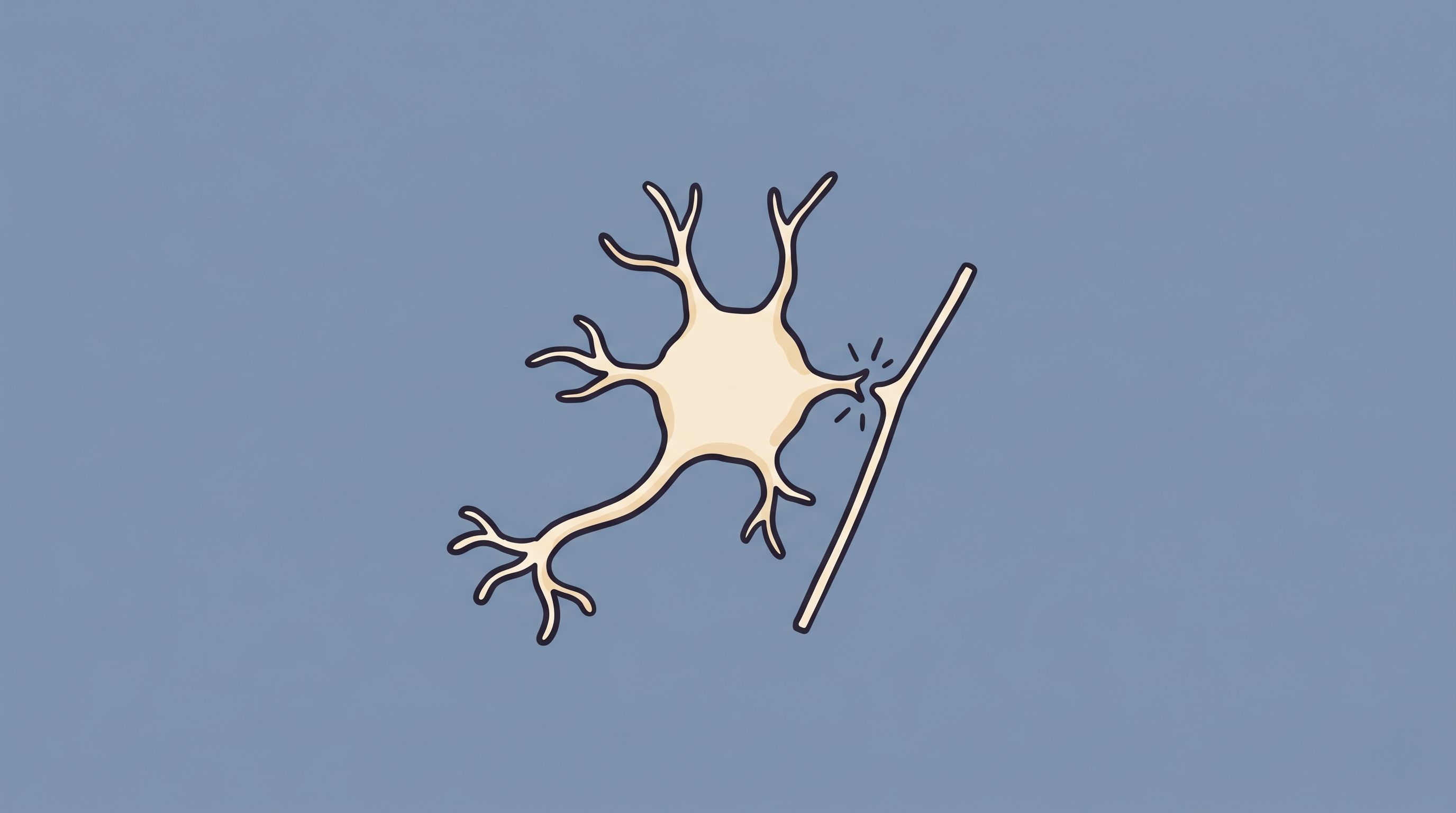
He opens with a story from 1958. In a basement at Johns Hopkins, two scientists, Hubel and Wiesel, ran a wire from a single neuron in a cat’s visual cortex to a speaker: fire the neuron, hear a pop. They spent weeks flashing dots at the cat and got nothing. Dead silence. Then one of them went to swap a glass slide in the projector, and the edge of the slide swept across the screen, and the speaker went off like a machine gun.
The neuron did not care about dots. It cared about an edge at one specific angle. Tilt the line away and it went quiet. Tilt it back and it screamed. They had found a single cell whose entire job was to notice that a line leans this particular way.
What Hubel and Wiesel showed, and what won them a Nobel in 1981, is that vision is not a camera. Your brain runs a stack of cells that each give a damn about one tiny stupid thing: a line at this angle, an edge moving that way. They called these simple cells. Simple cells feed into complex cells, which combine dumb things into slightly less dumb things. Edges become corners. Corners become shapes. Shapes become a face. You do not design a face detector. The face is what the stack produces.
Yann LeCun copied this blueprint in 1989 when he built the convolutional neural network. A CNN is a pile of small filters, each responsible for spotting something trivial in a little patch of an image, and when you stack and layer them they start recognizing cats and stop signs. The same idea that sat in a cat’s brain in 1958 is now driving cameras in self-driving cars. We did not invent it. We found it, and copied it.
I have been unable to unsee it since. I have a ten month old, and two black-capped conures, Tinku and Sweety. We have never sat my daughter down with a grammar rule. She gets blasted with signals: faces, sounds, the weight of a spoon, the consequence of dropping it for the fortieth time. Each one tiny and dumb on its own. Out of that pile, a person fits herself to the world. The birds are the same story at smaller scale. I show food, I make a sound, I point at a spot, and over many repetitions they have mapped those signals to an action. There was no moment where they got it. There was signal, reward, adjust, repeat, until a behavior that looks complex settled out of a loop that is breathtakingly simple.
The Bitter Lesson
In 2019 Richard Sutton wrote a short essay called The Bitter Lesson. The argument is brutal: over the long run, raw computing power consistently beats intricate human-designed solutions. Sixty years of AI researchers tried to encode their hard-won expertise into machines, and sixty years running they got beaten by methods that scaled up search and learning with more compute.
His examples are receipts. In chess, Deep Blue beat the world champion using a simple search algorithm scaled up with specialized hardware, defeating hand-coded grandmaster knowledge in the process. In Go, AlphaGo relied far less on human expertise about the game than the systems before it. Speech recognition and vision followed the same pattern. The clever, human-shaped approach feels good and loses.
The line that stings is Sutton’s conclusion: the actual contents of minds are tremendously, irredeemably complex; we should stop trying to find simple ways to think about what is in minds, and instead build only the meta-methods that can find and capture that complexity. Stop trying to be the smart one. Build the thing that learns, and step back.
It is called bitter because it takes away what we wanted to be true. We wanted intelligence to require ingenuity, some inalienable human spark. It mostly required electricity.
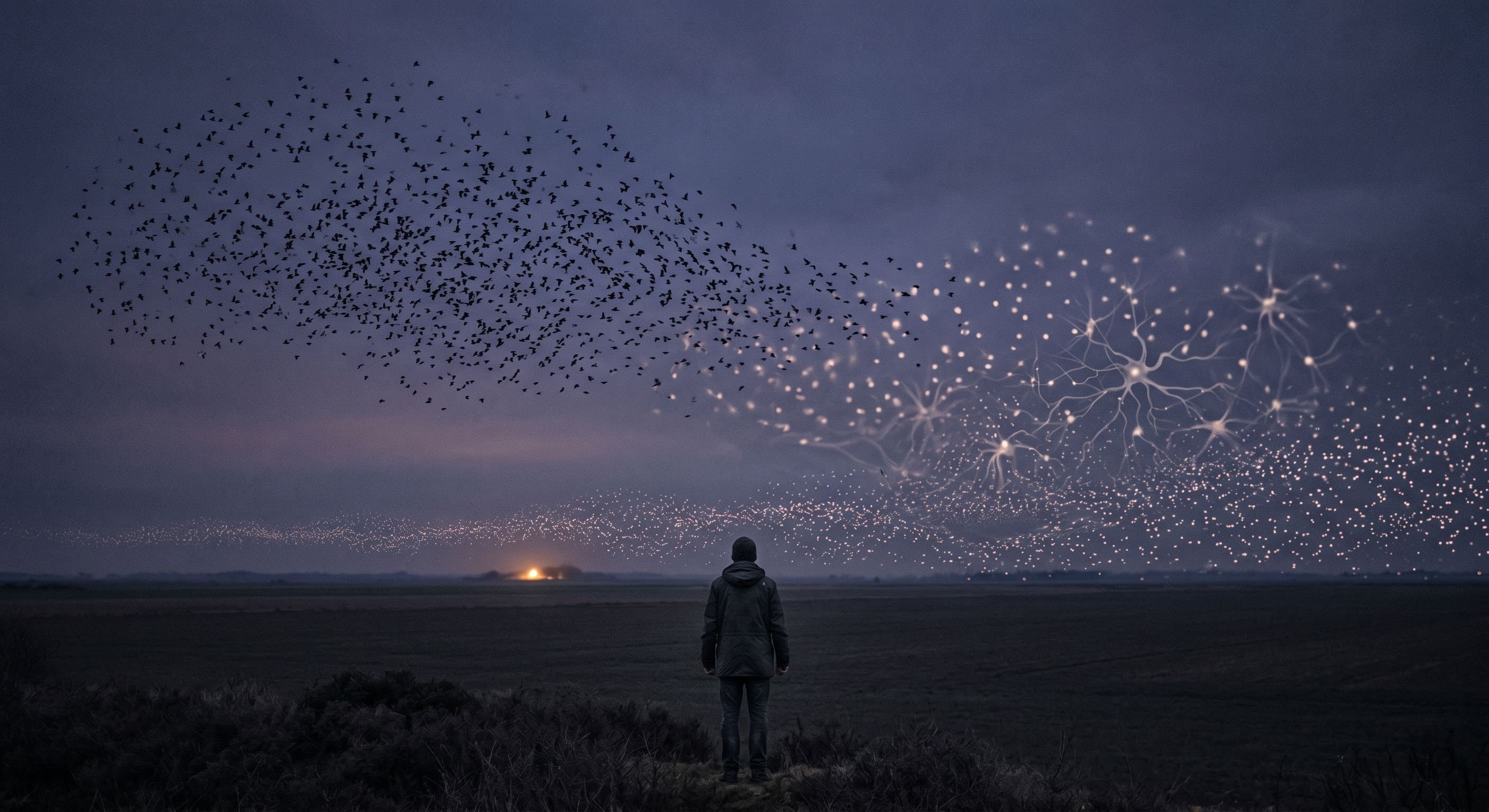
Once you have the pattern in your head you see it everywhere. A single ant will run in circles until it dies of exhaustion. No architect coordinates any of it. Each ant follows one rule: deposit and follow pheromone trails. The colony finds the shortest path to food and builds intricate nests with no central leader. A flock of starlings does its mesmerizing liquid thing with three local rules per bird: do not crash into your neighbor, match their direction, move toward the group. A neuroscientist named Mark Goldman watched films of ant colonies making foraging decisions and saw that it looked like what happens at the synapse of a neuron. Both systems accumulate evidence from their inputs, returning ants or incoming voltage, to decide whether to fire an output. So they started using ants to study brains and brains to study ants. Same math, different substrate.
The objection that LLMs are just autocomplete runs into the same wall. The model is not scored on the most common next word. It is scored on whether it gets the right next word for this specific context. If the most common word after “the” is “man” but this paragraph needs “lighthouse,” guessing “man” is a mistake, and that mistake nudges the model’s internal weights a hair. Do that across billions of examples and leaning on frequency stops working. The model has to start picking up what the sentence means. Researchers tested this with OthelloGPT: a model trained only to predict legal moves in the board game Othello, with no knowledge of the game or its rules, just sequences of moves. When they cracked it open, they found an internal representation of the board state, robust and far from a simple lookup table. The model had built a picture of a board it was never told existed. When researchers intervened on those internal board-state neurons, the model’s move predictions changed accordingly, which is causation, not correlation. A simple objective, predict the next token, created rich internal structure. The model fit a curve not to the data, but to the process that generated the data.
What it means to be human, apparently
Chasing this down has bummed me out a little.
My fallback move: fine, AI is smart, but it cannot do love or qualia, the texture of being alive. Maybe that is still true. I want it to be. But “simple things scaled up” has been haunting me, because if that is how the eye works, how a flock works, how an ant colony works, how my daughter and my parrots are learning right in front of me, then the expensive stuff, the meaning, the inner life, might be built out of the same material.
I do not have the answer. The human brain fit a curve to whatever helped our ancestors survive, and machines can fit a curve too. They are not the same, not yet. Maybe not ever. But the gap I assumed was a difference in kind might be a difference in scale, and that is a much harder place to stand.
AI first came for the jobs. Now it is poking at the one thing we kept for ourselves: the belief that there is something in here that is not just a process. I do not think that belief is dead. But I have stopped being sure it is safe.
That is why he called it the bitter lesson.
Go watch Mo’s video. It is ten minutes and it is better than this post.